
It's the Name - Stoopid!
The Power of Naming in Politics
The question is...who controls the naming?
The ability to name is a form of control. In the biblical story of Genesis, God grants Adam the power to name the animals, establishing that naming precedes dominion. To name something is to define its category, its relationships, and its permissible actions. This concept was later echoed in postmodern thought by thinkers like Foucault, who argued that discourse shapes reality rather than merely describing it. In both cases, the act of naming confers power over what is named.
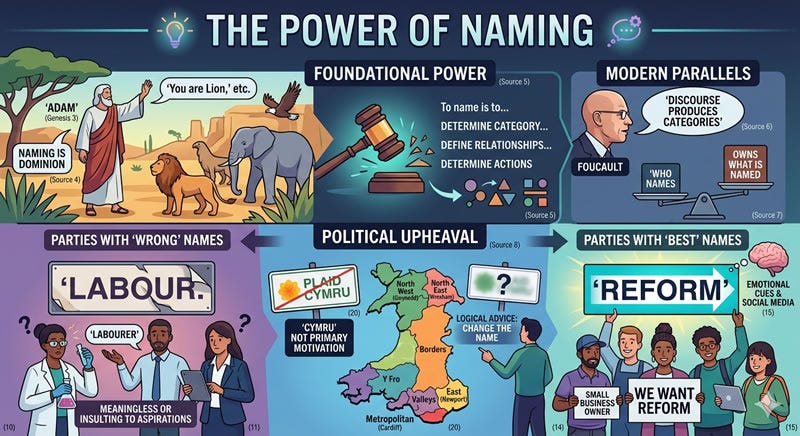
Today, we are witnessing significant political upheavals in Wales and around the world. Success in politics can hinge on the names of political parties. For instance, the name ‘Labour’ has lost its relevance in modern society. Few people identify as ‘labourers,’ and the term can even be seen as insulting to those with higher aspirations or non-manual jobs, such as scientists or even politicians. Thus, the name fails to resonate with or identify many potential supporters.
On the other hand, parties with names that evoke positive aspirations tend to perform better. ‘Reform’ is a prime example. The name suggests progress and improvement, qualities that resonate with voters seeking change in difficult times. Most voters do not follow political manifestos or policies; instead, they react emotionally to cues and unconscious biases, often influenced (aggravated) by social media algorithms and mainstream media. A party name that aligns with these emotional triggers can sway votes.
Some party names reflect the regions and countries they aim to represent, such as Plaid Cymru. However, voters are primarily motivated by economic and emotional concerns rather than national identity. Even Plaid Cymru’s recent success in local Senedd elections came from downplaying its ‘nationalist’ stance and focusing on other issues that resonated better with voters.
Wales itself can be divided into distinct regional identities: the Valleys, Metropolitan (Cardiff), East (Newport), A40 corridor, Y Fro (West), North West (Gwynedd), North East (Wrexham), and Borders (Shrewsbury). None of these regions prioritise ‘Cymru’ as their primary voting motivation, and their interests often conflict. Therefore, the name ‘Plaid Cymru’ may not appeal to the majority, particularly those who do not speak Welsh but do still identify as being Welsh.
Given these insights, the conclusion is that, long term, the party name is wrong and indeed off-putting to the majority particularly if they are non-Welsh speaking but still identify as ‘Welsh’.
What then should be the party name that would work for most people? Answers in the comments.